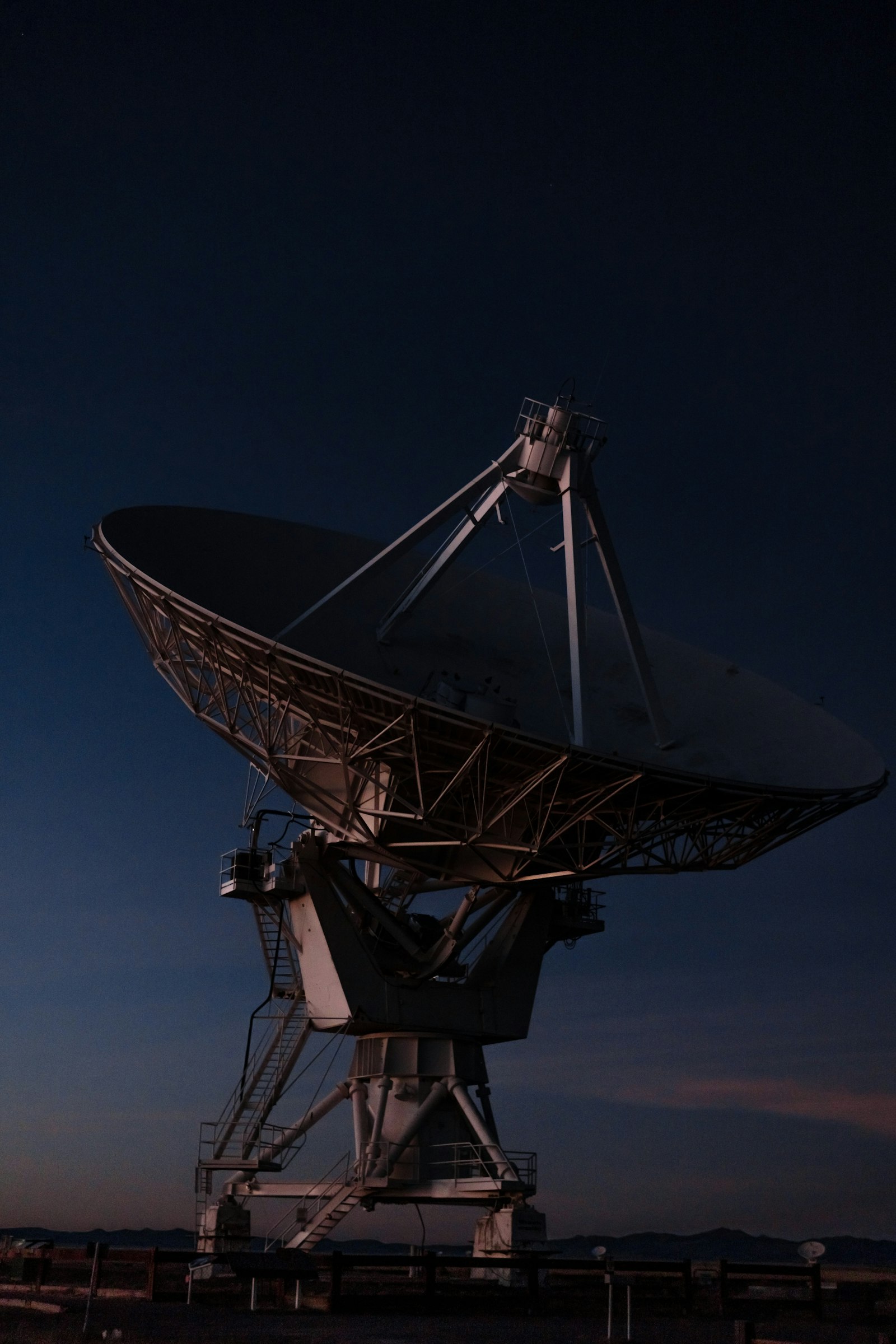
What the Krasukha-4 is
The Krasukha-4, designation 1RL257, is a ground-based radar jammer. Army Technology describes it as a "broadband multifunctional jamming station." It has an older sibling, the 1L269 Krasukha-2, and the two are often mentioned together.
They go after different radars. A 2017 report by the International Centre for Defence and Security in Tallinn describes the Krasukha-2 as built to jam the S-band radars used by airborne early warning planes, and the Krasukha-4 as built to jam the X and Ku-band fire control radars typically carried by fighter aircraft. Global Defence Technology adds that the Krasukha-4 is meant to jam ground surveillance radar planes like the American JSTARS.
Russia claims more than that. In 2015 its maker said the Krasukha-4 can also disrupt satellites in low Earth orbit, can hit ground-based radars and "can cause permanent damage to targeted radio-electronic devices." The War Zone notes that the damage claim is unverified. Russia's arms exporter, Rosoboronexport, pitches the family as protection for command posts and troop concentrations: it jams enemy radars so that "enemy aircraft lose their capability to detect targets and aim their precision weapons against them." CSIS notes that it also reportedly interferes with "observations of radar reconnaissance satellites."
How far it reaches, and who says so
Range is where the numbers get slippery. The commonly quoted 150 to 300 kilometers is the manufacturer's figure, and The War Zone points out it's unclear whether that means detection range, jamming range or both. Other sources pick a single number.
| Source | Range given for the Krasukha-4 |
|---|---|
| Manufacturer, as reported by The War Zone | 150 to 300 km |
| Army Technology | Effective radius of 300 km |
| ICDS report (2017) | Up to 300 km against airborne radars, "allegedly" |
| CSIS Space Threat Assessment 2022 | 180 miles |
| Militarnyi (2025) | Specifications classified; 300 km unconfirmed |
For comparison, the maker said in 2015 that the Krasukha-2 could jam airborne early warning aircraft at up to 250 kilometers. Treat all of these as claims. None of them is backed by a published independent test.
Who builds it, and on what
The system comes from KRET, the Concern Radio-Electronic Technologies, a subsidiary of the state conglomerate Rostec. Photos leaked in 2025 confirmed it is assembled at the Bryansk Electromechanical Plant, which Militarnyi places about 120 kilometers from the Ukrainian border. The role of the Gradient research institute is reported two ways: a Russian outlet calls it a developer, while Poland's Defence24 lists it as a subcontractor.
The vehicles are disputed too. KRET said in 2015 that the Krasukha-4 sat on a BAZ-6910-022 four-axle chassis. Later reporting, including the leaked factory photos, shows two KamAZ-6350 8x8 trucks, one carrying the jamming equipment and one the command post. Defence24 explains part of the mix-up: the Krasukha-2 used BAZ chassis. Army Recognition lists a crew of three, the only crew figure we found, and no source gave a setup time.
Next guide: hypersonic missile defense
Why gliders slip under ground radars, and the interceptor the U.S. and Japan are building.
Deliveries since 2013
Sources can't agree on when it entered service, with dates from 2010 to 2014 in print. Defence24, citing Russian reporting, said serial production started in 2011, that the first batch of four systems reached the forces in March and April 2013, two more followed that November, and at least ten were in service by the end of 2013.
Deliveries kept coming. In March 2016 Igor Nasenkov, KRET's first deputy CEO, said the company would deliver "several systems" that year but called them "classified contracts." That December TASS reported that Russia's Western Military District had received about 10 new electronic warfare systems, including "several Krasukha-4" sets.
Russia has also tried to sell it. A KRET official said in 2015 that there were foreign buyers for both Krasukhas. Rosoboronexport signed its first Krasukha export contract in August 2021 without naming the customer, and in 2023 an industry source told TASS of plans to deliver the system to several Southeast Asian countries. In September 2025 Serbia showed off a Krasukha-2 and a Krasukha-4 at a military parade in Belgrade.
Syria
Syria is the deployment with the most documentation. In October 2015, the ICDS report says, Russia sent the Krasukha-4 to its Khmeimim air base in Latakia, "probably" to help protect the base from air attack alongside its air defenses. The same report cautions that Russian coverage "tends to talk up or exaggerate" what electronic warfare achieved there.
American commanders felt something. In 2018 Gen. Raymond Thomas, who then led SOCOM, called Syria "the most aggressive E.W. environment on the planet" and said adversaries were "knocking our communications down, disabling our EC-130s." He didn't name Russia or any specific system.
Ukraine: a capture and some strikes
CSIS noted reports of Krasukha-4 jammers near Gomel in Belarus before the February 2022 invasion. A month into the war, Ukrainian forces found part of one outside Kyiv: the containerized command post module, not the jammer truck. The Telegraph described it as "partly damaged but otherwise intact," lying on its side with no sign anyone had tried to destroy it, and said it would "likely" go to Ramstein Air Base in Germany and on to the United States. We found no official confirmation that it did.
Since then, the public record is mostly claims from each side. A Russian Defense Ministry video in June 2022 said a Krasukha crew had neutralized the radar of a Ukrainian reconnaissance drone. In November 2023 Ukraine said it destroyed a Krasukha-4 in a forest in the Zaporizhzhia region, and Militarnyi called it only the second such system recorded among Russian losses. Even the weapon is reported differently: Militarnyi said two shells, Army Recognition said two JDAM guided bombs. On September 3, 2026, Ukraine's General Staff said it had struck another Krasukha-4 near Sevastopol in Crimea, with the extent of the damage still being assessed.
In October 2025 a hacker group calling itself Black Mirror released detailed photos of the Krasukha-4 and its production line, along with company financial documents. Polish site CHIP.pl said the material came from Rostec's archives.
Get the briefing
An occasional email on electronic warfare, missiles and the rest of the hardware beat.
How much does it matter?
Here the honest answer is that nobody has published a public assessment of the Krasukha-4 on its own. The detailed studies cover Russian electronic warfare as a whole, and most of that is short-range jamming of drones, radios and GPS by other systems.
Those studies show why the whole field worries NATO planners, a topic our NATO explainer touches on. RUSI found that in 2022 Russia set up "up to 10 complexes per 20 km of frontage" in the Donbas, and that Ukrainian pilots "often had their air-to-ground and air-to-air communications jammed, their navigation equipment suppressed, and their radar knocked out." In its 2023 Stormbreak report it said that when Russian electronic warfare was active, Ukrainian drones "could not get in and usually were not committed." The same researchers also found weak spots: Russian jammers hurt Russian troops too, and "direct jamming against precision systems was rarely effective." Thomas Withington, writing for RUSI, judged that jamming of American JDAM bombs "is not causing the JDAMs to stop working, but it is risking their accuracy."
The drone threat that pushed Ukraine's Abrams tanks back from the front is the other half of that fight. The Krasukha-4 sits at the high end of it, aimed at the big radar planes and satellites that let a modern air force see the battlefield.
Sources
- Army Technology: Krasukha electronic warfare system, Russia
- ICDS: Russia's Electronic Warfare Capabilities to 2025
- Global Defence Technology: Russia's electronic warfare
- TASS: Foreign buyers interested in Russia's Krasukha electronic warfare systems
- TASS: Russian military units get cutting-edge electronic warfare systems
- TASS: Rosoboronexport signs first Krasukha export contract
- TASS: Krasukha deliveries planned for Southeast Asia
- Army Recognition: Russian forces will receive Krasukha-4 and Moskva-1
- Army Recognition: 1RL257 Krasukha-4 jamming station
- Defence24: Russia's answer to AWACS and drones, the Krasukha system
- The War Zone: Ukraine just captured part of one of Russia's most capable EW systems
- The Telegraph: Russian military secrets could be laid bare after Ukraine captures EW systems
- CSIS: Space Threat Assessment 2022
- The Defense Post: Russian electronic warfare in Syria
- Zenger News: Russia claims electronic warfare system took out Ukrainian drone
- Militarnyi: Ukrainian forces eliminate Russian Krasukha-4 in Zaporizhzhia region
- Army Recognition: Ukrainian forces destroy Krasukha-4 with JDAM
- Ukrainska Pravda: Ukraine strikes Russian boat and electronic warfare system
- Militarnyi: Hackers leak detailed photos of the Krasukha-4
- CHIP.pl: Leaked Rostec files on the Krasukha-4
- www1.ru: Serbia showed off Krasukha-2 and Krasukha-4
- RUSI: Preliminary Lessons in Conventional Warfighting from Russia's Invasion of Ukraine
- RUSI: Stormbreak, Fighting Through Russian Defences in Ukraine's 2023 Offensive
- RUSI: Jamming JDAM, the threat to US munitions from Russian electronic warfare