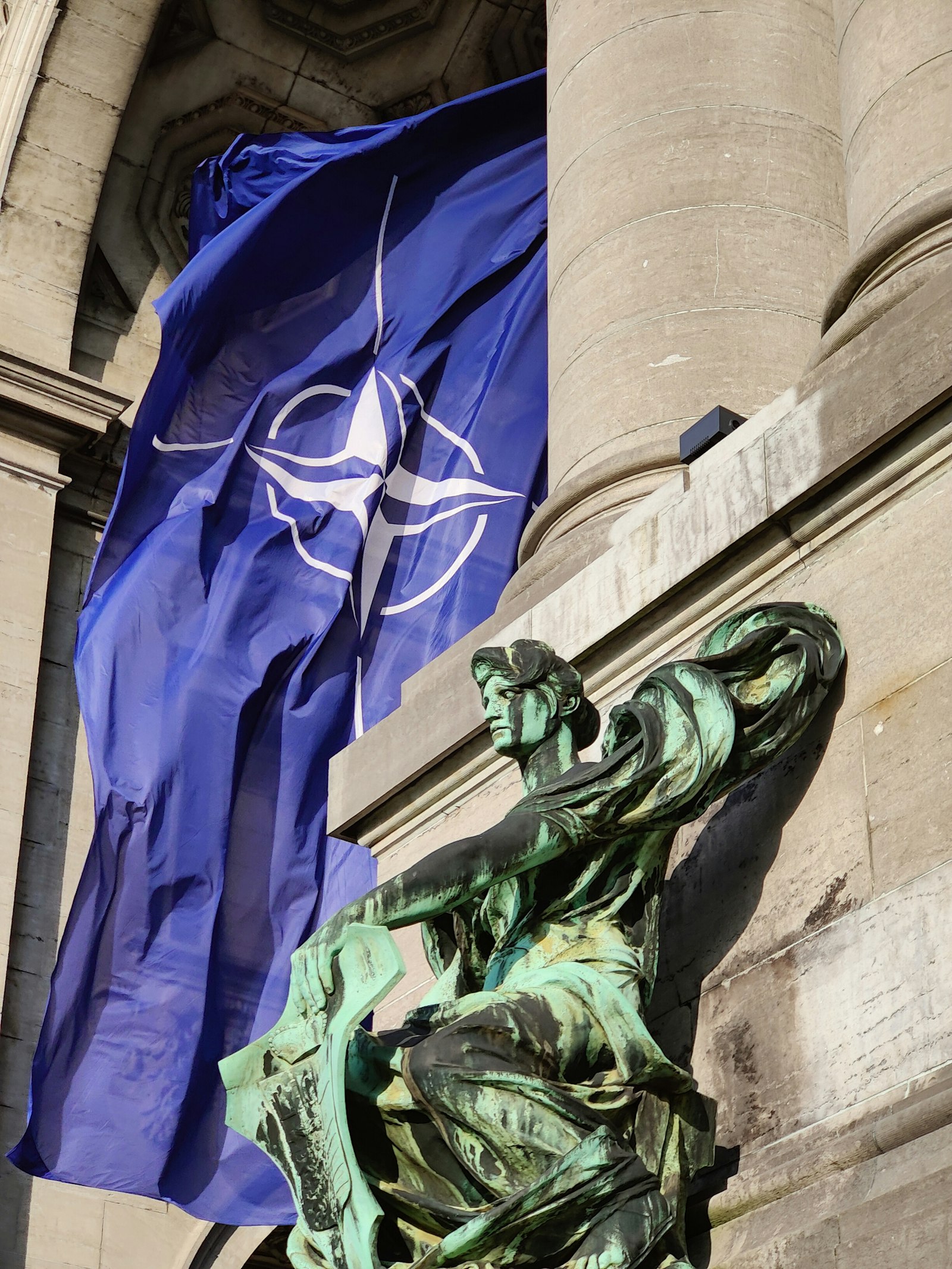
What NATO is
The North Atlantic Treaty Organization is a military alliance of countries in Europe and North America. It was founded on April 4, 1949, when twelve countries created it with the North Atlantic Treaty, often called the Washington Treaty. Its headquarters is in Brussels.
NATO describes its members as sovereign states that decide things collectively. Every decision is made by consensus, which means all 32 members have to agree, and the main forum for those decisions is the North Atlantic Council.
The council is chaired by the Secretary General. Mark Rutte took the job on October 1, 2024, succeeding Jens Stoltenberg, who had held it for a decade.
Members and when they joined
The alliance has grown in waves. Here is every member, grouped by the year it joined:
| Year | Countries |
|---|---|
| 1949 | Belgium, Canada, Denmark, France, Iceland, Italy, Luxembourg, Netherlands, Norway, Portugal, United Kingdom, United States |
| 1952 | Greece, Türkiye |
| 1955 | Germany |
| 1982 | Spain |
| 1999 | Czechia, Hungary, Poland |
| 2004 | Bulgaria, Estonia, Latvia, Lithuania, Romania, Slovakia, Slovenia |
| 2009 | Albania, Croatia |
| 2017 | Montenegro |
| 2020 | North Macedonia |
| 2023 | Finland (April 4) |
| 2024 | Sweden (March 7) |
Joining isn't automatic. Under Article 10 of the treaty, membership is open to a "European State in a position to further the principles of this Treaty," and an invitation needs the agreement of every existing member. Ukraine's bid has been pending since 2008.
The two newest members show how the process ends. Finland became the 31st when it deposited its instrument of accession on April 4, 2023, the alliance's 74th birthday. Sweden followed as the 32nd on March 7, 2024.
Article 5: an attack on one is an attack on all
Article 5 is the core of the treaty. It says an armed attack on one or more members in Europe or North America counts as an attack on all of them, and that each will help the country attacked by taking "such action as it deems necessary," which can include armed force, to restore security in the North Atlantic area.
Two details matter here. First, the clause doesn't spell out what help each country must send. NATO's own explanation is that "it is up to individual Allies to determine how they will implement the mutual assistance obligation," and that the response doesn't have to be military. Second, some members need their parliament's approval before sending troops abroad, and Article 11 of the treaty allows for that.
Article 5 has been invoked exactly once, and it was for the United States. After the attacks of September 11, 2001, the council confirmed on October 2 that they counted as an attack under Article 5. Two days later allies agreed on eight measures, including intelligence sharing and access to ports and airfields. Seven NATO AWACS radar planes then flew patrols over American skies from October 2001 to mid-May 2002 in Operation Eagle Assist, and allied warships began patrolling the Mediterranean in Operation Active Endeavour, which ran until 2016.
Next guide: two allies, one missile program
How Norway and Germany tied a submarine sale to a missile deal.
Article 4: the call for consultations
Article 4 is used far more often. Any member can request talks when it believes its territory, independence or security is threatened. Asking for Article 4 doesn't mean Article 5 is coming; it's a formal way to put a threat on the table.
NATO lists nine occasions so far:
- Türkiye asked five times: in February 2003, twice in 2012, in July 2015 and in February 2020.
- Poland asked on March 3, 2014, and again on September 10, 2025.
- Eight eastern members asked together on February 24, 2022: Bulgaria, Czechia, Estonia, Latvia, Lithuania, Poland, Romania and Slovakia.
- Estonia's request led to a council meeting on September 23, 2025, after an airspace violation four days earlier.
What members pledge to spend
For years the yardstick was 2 percent of GDP on defense. NATO's annual report for 2025, presented by Rutte in March 2026, said every member met or beat 2 percent that year for the first time. Spending by European members and Canada rose 20 percent, or $94 billion, over the year before. The United States still accounts for about 60 percent of all defense spending by NATO nations, Breaking Defense reported. Rutte gave Washington the credit: "I don't believe that without the present American administration, the whole of the alliance would have been meeting" the target, he said.
The target has since moved. At The Hague summit on June 25, 2025, leaders agreed to spend 5 percent of GDP a year by 2035, split into two parts:
- At least 3.5 percent on core defense, counted under NATO's existing definition.
- Up to 1.5 percent on related needs such as protecting critical infrastructure, defending networks, civil preparedness and the defense industrial base.
Each member is supposed to file a yearly plan showing a "credible, incremental path" to that goal, and the balance of the plan is due for review in 2029. Equipment is the bottleneck. NATO puts shared needs for missiles, bombs, drones and long-range strike weapons at up to $145 billion, and Rutte told reporters "the defense industrial base is simply not producing enough," even though, by his account, output had risen sixfold in a couple of years.
Get the briefing
Alliance news and summit outcomes, minus the jargon, by email.
The 2026 Ankara summit
The most recent summit met in Ankara, Türkiye, in July 2026. The declaration renewed the Article 5 commitment. Allies pledged 70 billion euros, about $80 billion, in military equipment and training for Ukraine and committed to at least the same level in 2027, but Ukraine's membership bid saw no visible progress.
NATO also said it would buy up to 10 Swedish GlobalEye surveillance planes to replace its aging E-3 AWACS fleet, dropping an earlier plan for Boeing's E-7 Wedgetail. And the host country got no breakthrough on the F-35: Türkiye was removed from the program in 2019 after it bought Russian air defense systems, and it didn't rejoin in Ankara. Our Türkiye page covers its armed forces in more detail.
Why it matters to Americans
The United States is NATO's biggest spender and the only member for which Article 5 has ever been invoked. For one piece of the American military footprint on allied soil, read about the U.S. missile defense site in Romania. For a sense of how the allies' armed forces compare in size with the rest of the world, see our ranking of armed forces by active-duty headcount.
Sources
- NATO: Member countries
- NATO: Collective defence and Article 5
- NATO: The consultation process and Article 4
- NATO: The Hague Summit Declaration
- Breaking Defense: NATO sees $145B in munitions needs as members all hit 2 percent of GDP
- Breaking Defense: Six takeaways from the 2026 NATO summit
- UK Defence Journal: Mark Rutte takes office as new NATO Secretary General
- NATO: Partnerships and cooperation