Seven commandos, one force
The commandos marine are the French Navy's special forces. They belong to the Force maritime des fusiliers marins et commandos, known as Forfusco, which has its headquarters near Lorient in Brittany. In its November 2026 issue the Navy's magazine, Cols bleus, put Forfusco at about 2,900 sailors. The Navy's website gives a lower figure of about 2,600 spread across 18 units on 10 sites.
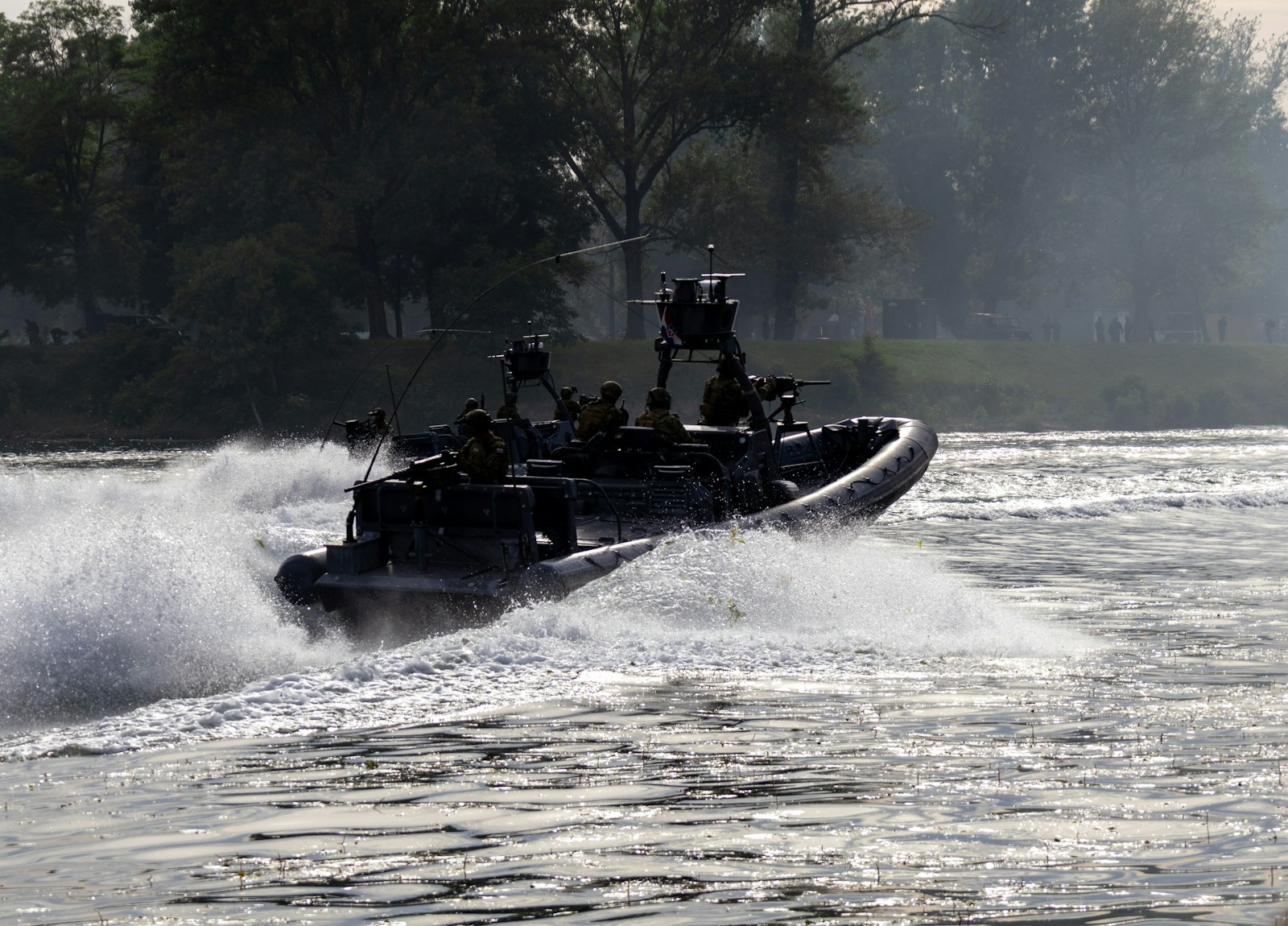
Forfusco has two halves. The fusiliers marins are naval infantry who guard sensitive sites, including those tied to France's nuclear deterrent, and protect high-value ships such as aircraft carriers and submarines. The commandos are the offensive side. They can be placed under France's Special Operations Command (COS), used by the Navy itself or handed to another commander, and the Navy describes three fields for them: action on the open sea, from the sea onto land, and special operations ashore. Forfusco's commander told Cols bleus they also take on naval combat, counter-trafficking and maritime counterterrorism missions.
The magazine's breakdown of the seven units:
| Commando | Role | Base |
|---|---|---|
| Jaubert | Assault | Lorient area (Lanester) |
| Trepel | Assault | Lorient area (Lanester) |
| de Montfort | Assault | Lorient area (Lanester) |
| de Penfentenyo | Assault | Lorient area (Lanester) |
| Hubert | Combat swimmers, underwater action | Saint-Mandrier, near Toulon |
| Kieffer | Support, specialized cells | Lorient area (Lanester) |
| Ponchardier | Support, mobility and logistics | Lorient area (Lanester) |
The page this one replaces gave de Montfort and de Penfentenyo a reconnaissance, intelligence and neutralization role. The Navy's 2026 description simply counts them among four assault commandos. Kieffer runs nine specialized cells, one of them a cyber cell working since 2024 on collecting cyber intelligence. Its members aren't commando-qualified, Cols bleus noted, but they get intensive military and physical training so they can deploy with a special forces detachment.
What Commando Ponchardier does
Cols bleus says Ponchardier was created as a support commando in 2015 to give Forfusco as much autonomy as possible and make it quicker to react. That matches the year given on the old version of this page. Its job has two parts:
- Mobility support: tactical vehicles and their drivers, boats and their crews, and the gear and specialists for airdrops.
- Operational support: managing, maintaining and issuing equipment, moving materiel and running training.
In practice that means the shops. The unit has a special equipment squad, a metal workshop staffed by civilian state workers who keep up with changes to the gear, and a special weapons maintenance workshop. Since it opened in 2006, which predates the commando itself, that workshop has carried out more than 30,000 inspections and more than 5,000 repairs, according to the magazine.
The name isn't new to the Navy. After World War II Pierre Ponchardier formed and trained a parachute commando that fought in Indochina in 1945 and 1946, and a Cols bleus photo shows him leading his commando marines on parade during that war. The 2015 unit carries his name.
Next guide: the U.S. Navy SEALs
How the American Navy screens and trains its own special operators.
Who Pierre Ponchardier was
The Ordre de la Libération, which keeps the records of France's Companions of the Liberation, gives the outline. Pierre Ponchardier was born on October 4, 1909, in Saint-Étienne. In late 1942 he and his brother Dominique set up the Sosies intelligence network. Dominique ran its northern zone, and Pierre ran the southern zone and a maritime section that covered the whole French coast. He was made a Companion of the Liberation by decree on January 20, 1946.
His postwar career ran through ships and staff jobs. After the Indochina commando he commanded the Commandant Robert Giraud in the Far East in 1947 and 1948, and later the aircraft carrier La Fayette. He became major général of the port of Toulon in 1957 and deputy chief of the Navy's general staff in 1958. Promoted vice admiral in March 1960, he took command of the South Atlantic maritime zone, based in Dakar.
The earlier version of this page said Ponchardier died in combat in 1961. He didn't. He was killed in a plane accident at the Tambacounda airfield in Senegal on January 27, 1961.
Earning the green beret
Every commando marine comes through the same course at the École des fusiliers marins near Lorient. The stage commando, created in 1946 and now officially the commando certificate course, turned 80 in 2026. Any sailor who wants to can try. Selection runs twice a year over three weeks and is built around three obstacle courses the instructors call the Jungle, the Commando and the Assault. Those kept after the three weeks go on to the seven-week commando course itself.
Cols bleus watched one session. On the day of its visit 42 trainees started the Assault course, and the magazine said a little under half of that session would end up with the beret. Even then it isn't permanent. The beret is put back on the line at every later qualification, from team leader to group leader to commando mission leader, the school's head of commando training told the magazine. He described what they look for this way: "We don't want racehorses or top-level athletes, but resilient people of a good standard with sound heads who can stay clear-minded in any circumstances."
The older version of this page gave a 20-week course, a nine-month service requirement and an 82 percent dropout rate. We couldn't confirm those figures, and the Navy's current description of a three-week selection followed by a seven-week course doesn't match them, so they're gone.
Commandos in action: Burkina Faso, 2019
Few commando operations are described in public. This one was, by the French president himself. On the night of May 9 to 10, 2019, French special forces freed four hostages in northern Burkina Faso: two Frenchmen who had been kidnapped in Benin eight days earlier, an American woman and a South Korean woman. The Telegraph's report on the hostage rescue named the two commandos killed in the raid, Cédric de Pierrepont and Alain Bertoncello. Both were from Commando Hubert. President Emmanuel Macron led a national tribute to them at the Invalides in Paris on May 14, 2019, and promoted both men posthumously to premier maître.
Get the briefing
Occasional emails when we publish on allied navies and their commandos.
Where the commandos came from
The fusiliers marins date to 1856, set up after the lessons of the Crimean War, and the commandos grew out of World War II. The French course descends directly from Achnacarry, the British commando training center in Scotland, where a British officer, Col. Vaughan, trained Lt. Philippe Kieffer and the first 40 commandos of his company of naval infantry.
Kieffer's 177 commandos were, in Cols bleus' words, the only French soldiers in uniform to land in Normandy on D-Day. The wider landing is broken down in D-Day by the numbers.
For other French routes into elite service, see our guide to joining the Foreign Legion, which is open to foreigners, or browse the world militaries hub.
Sources
- Cols bleus no. 3141, November 2026 (French Navy magazine, PDF)
- Marine nationale: Cols bleus no. 3141, Dans l'ombre
- Marine nationale: Notre organisation
- Ordre de la Libération: Pierre Ponchardier
- Élysée: Hommage national à Cédric de Pierrepont et Alain Bertoncello
- The Telegraph: Two commandos killed as French special forces free four hostages